
Human Pattern Series: The Illusion of Choice and The Beauty of The Flow
On free will, resonance and convergence

A question that is frequently on my mind. So, I decided to write about it today.
Do we control our choices?
It’s one that often comes up in philosophy groups – does free will exist?
I believe it does, but only to a degree. Let me explain.
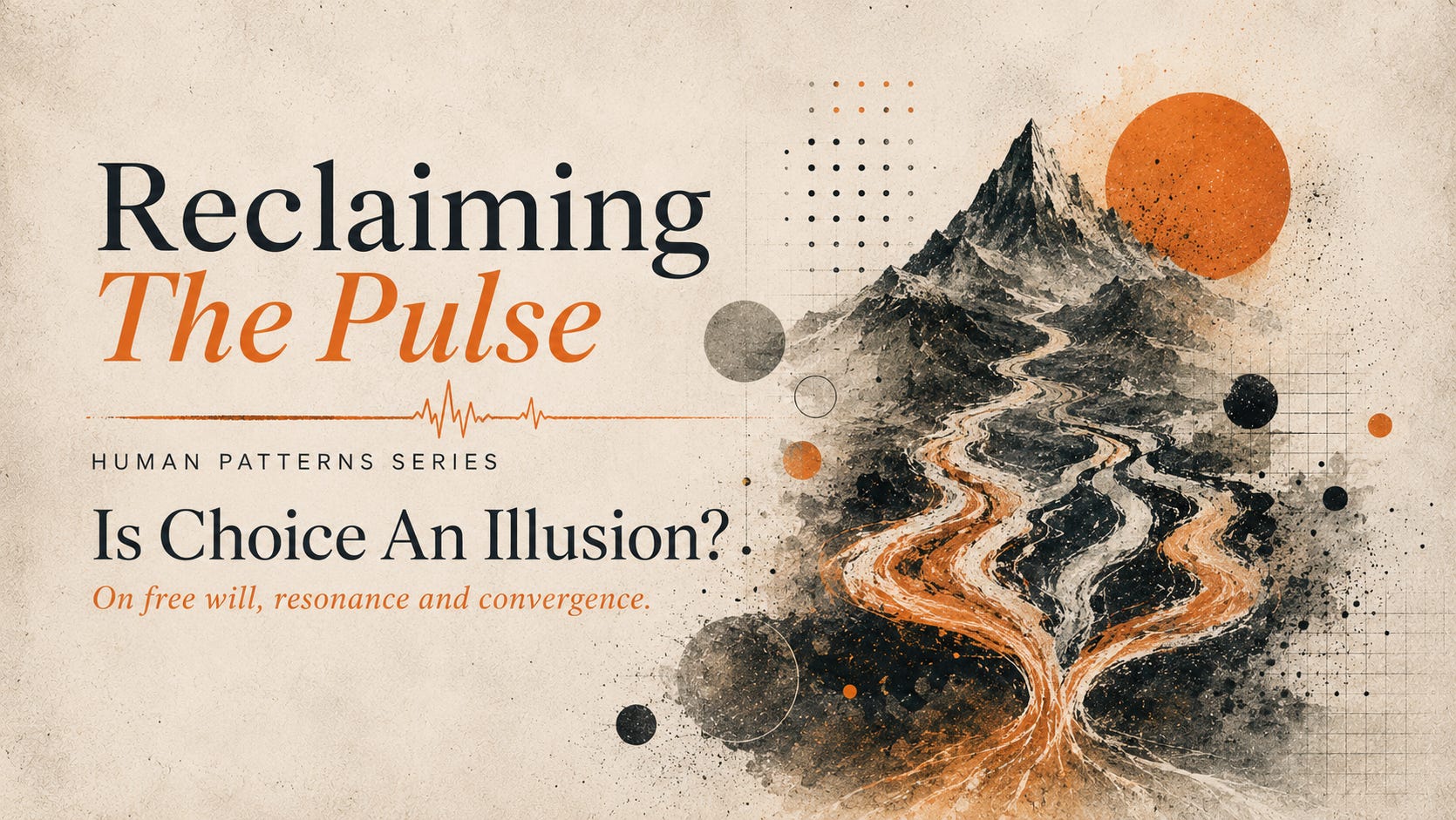
I like to think of life like a flowing river. Think of how a river flows down a mountain, finally out to sea. A river possesses gravitational energy; it carves steep V-shaped valleys. It has rapids, waterfalls, multiple streams, nooks and crannies.
The water carves out the path. But the path also carves the water – shapes its speed, its temperature, what it picks up and carries with it and what it leaves behind. There’s a reciprocity here that’s easy to miss. We don’t just move through our circumstances; our circumstances move through us, leaving deposits, sediment, and minerals that eventually become part of what we’re made of.
The pauses
The nooks and crannies act as the pauses in life – the quiet, forced pauses, sometimes when we’re feeling stuck, sometimes when we take time out. These aren’t failures of momentum. Even in the eddies, the water is still moving, still exchanging, and still being shaped. Stillness, when looked at closely, is rarely as still as it appears.
A river is rarely just one single line of water. It starts as dozens of isolated streams, born from different springs – different families, different accidents of geography, different early experiences none of us chose. Over time these streams collide, they blend together and create the powerful identity of who you are. By the time the river is wide and recognisable, it’s almost impossible to trace any single drop back to its original source. We are not one origin.
Over time, the valleys are carved out. The path is deepened. The longer water flows along a route. It isn’t predetermined but repetition itself creates a kind of gravity. Habits work this way. Identities work this way. The groove becomes easier to follow than the climb out of it, which is neither good nor bad – it’s simply how the terrain is built.
Sometimes a river hits a part of the mountain that causes it to split – this is called a braided river. These splits signal choice and uncertainty. The beautiful thing is, it doesn’t matter which one is followed, because they all recombine and lead to the same destination.
The cross roads
The river takes the path of least resistance. It learns to adapt, to be fluid, to move around obstacles. This isn’t weakness or a lack of will – it’s a different kind of intelligence. The water that insists on going straight through solid rock either wears itself down to nothing or waits millennia. The water that bends around finds the sea far sooner, and arrives with more of itself intact.
When you stand at a crossroads in life, it can look like there are two paths – one leading to success, the other to a cliff edge. We tell ourselves stories about the one that got away, the version of us that took the other job, married the other person, stayed in the other city. We imagine that version as somehow more complete, more correct, living a life we were owed. But rivers show us a different geometry entirely.
When the braided river splits, one stream might take a long detour, another might slow down through a more sluggish channel. But the key thing is, every single stream is still moving forward. None of them stop. None of them are wrong. None of them are waiting for the others to catch up, because there’s no race – there’s only flow.
There are perhaps few choices in life that can truly ruin the whole trajectory of who we become. A detour, a career change, a move to a different city – these are simply different channels of the same river. They might look like separate paths, but underneath, they’re all carrying the same water, shaped by the same source, heading toward the same sea. Even the channel that seems to go nowhere – the dead-end job, the relationship that ended, the years that felt wasted – is still depositing sediment somewhere downstream. Nothing is wasted, even when it feels like it at the time.
Decision Paralysis
We often paralyse ourselves by thinking a choice is final – that picking wrong means losing some other, better version of our life forever. But in reality, life recombines. It converges. Random opportunities bring us back to certain people, certain passions, certain versions of ourselves we thought we’d left behind. The friend you lost touch with reappears five years later at exactly the right moment. The skill you abandoned becomes useful in a job you never expected to take. The city you didn’t move to sends someone into your life anyway. The river doesn’t keep score of which channel was “right.” It just keeps moving and trusts the landscape to do the rest.
The freedom in the unknown
To look at it this way can be freeing: when the river splits, it doesn’t actually make a choice in the way we imagine choice to be – agonised, weighed, deliberated for months, and replayed afterwards with regret. It the pull of the earth, and slips into whatever crack is open enough to receive it. The momentum is created by gravity – by the conditions, the terrain, the forces already in motion long before that moment of splitting ever arrived. Every choice we make is downstream of a thousand things we never chose: where we were born, what we were taught to fear, what was modelled to us as possible. Free will, if it exists, doesn’t operate in a vacuum. It operates within a current.
Maybe that’s what free will actually looks like. Not some godlike power to choose any path with infinite, equal possibility – but a kind of responsiveness. A willingness to notice which crack is open, and to flow into it without needing to know in advance where it leads. The freedom isn’t in escaping the pull of gravity – it’s in how we move with it. With resistance and rigidity, or with adaptability and grace.
But this raises the obvious question. If the river doesn’t deliberate, if it simply slips into whatever crack is open – how do we know which current to flow into? We’re not water. We have minds that worry, that compare, that ask “but what if I choose wrong?”
This is where resonance comes in.
Flowing with resonance
Resonance is the felt sense of alignment – the moment something clicks before you can explain why. It’s not logic, and it’s not impulse either. It’s something subtler and older than both. Think of a tuning fork struck near another of the same frequency – the second one begins to hum, untouched, simply because the conditions are right for it to respond. Resonance works like this. Certain paths, certain people, certain decisions seem to hum back at us before we’ve reasoned anything out. It just feels right. Not in the sense of comfortable or easy – often the resonant path is the harder one – but in the sense of true. Aligned. Like something in you recognises something in it.
I think resonance is how the river “chooses” without choosing. It’s gravity, translated into feeling. When a stream finds the crack that’s open, there’s no internal debate – there’s just a kind of fit, a give in the landscape that matches the shape of the water. For us, resonance is that fit. It’s the body knowing something before the mind has caught up. The tightening in your chest when you say yes to the wrong thing. The exhale when you finally say no. The pull toward a person, a place, a piece of work, that you can’t fully justify but also can’t ignore.
We’re taught to distrust this. We’re taught that real decisions should be rational, weighed, defensible on paper. Reason has its place – it can rule out the obviously harmful, but reason alone can’t tell you which of two good paths is yours. That’s not a calculation. That’s a resonance. Learning to listen for it – really listen, underneath the noise of what we should want – might be the closest thing we have to free will in action.
Finding peace
Zooming out, and reframing the illusion of the “wrong choice,” can bring real peace. Not because choices don’t matter – they shape the terrain, deepen certain valleys over others, and some genuinely lead somewhere harder than others. But because no single choice carries the entire weight of your life on its own. You are not one decision away from ruin, or from salvation. You are a river: many streams, constantly recombining, carrying everything you’ve ever been, always finding your way – however winding, however slow, however unrecognisable from where you started – back to the sea. And when you’re not sure which way to flow, you can stop asking which path is correct, and start asking which one hums.
Moira, the river metaphor gives this piece its deepest wisdom because it refuses the false drama that every decision must be either salvation or ruin. I appreciate how you hold choice and formation together: we move, but we are also moved by terrain, inheritance, repetition, circumstance, memory, and the grooves carved before we had language for them. The braided river image is especially clarifying because it allows for real divergence without making every detour a verdict on the life we should have lived. What stayed with me most is the move from correctness to resonance, from asking which path can be defended on paper to asking which one hums with truth in the body and soul. Grateful for the peace this offers: that life may be less about escaping the current than learning to move through it with attention, adaptability, and grace.
Beautiful and excellent writing. I founda strong resonance with this. Thank you.