
Human Patters Series: The algorithm life
and the anomaly

Reclaiming the Pulse: Human Patterns Series
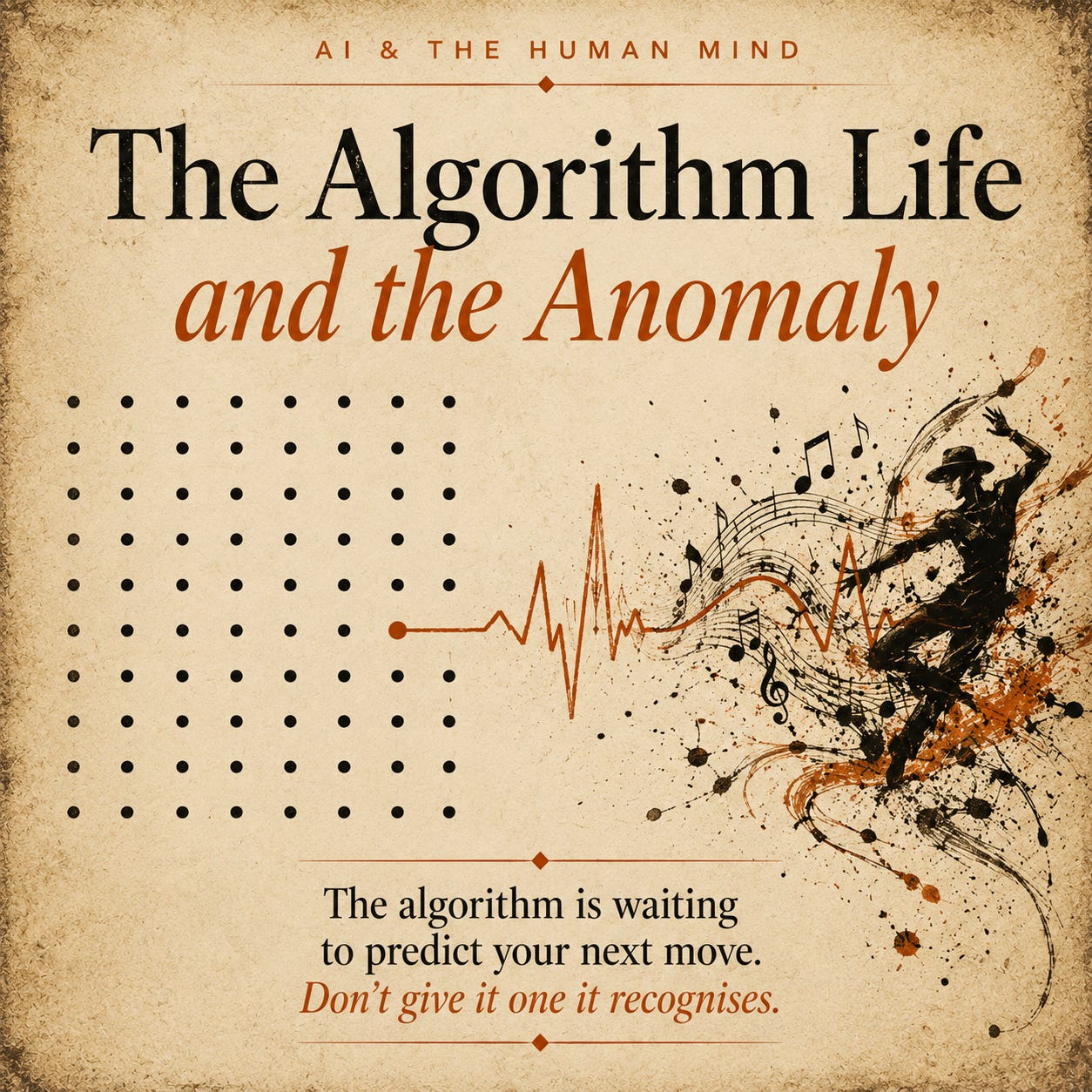
The algorithm life
and the anomaly
The algorithm makes us feel detached
Most of us must have felt it. I’ve felt it — I can’t think of the one word to describe it, but it feels like a combination of detachment, disconnection, and living with a little less colour. It’s not depression, as life is ok. But I was feeling a bit less than fully alive.
Time passes, we speak to people and say where has the time gone? We might laugh about it and move on, but underneath we are thinking to ourselves about what the hell we have done so far this year.
There is this underlying current of I should have travelled, I should have changed jobs, I should have finished that book.
The algorithm pushes us to achieve certain goals. All of us. The same ones.
The digital economy
This did not happen by accident. In the early twentieth century, Edward Bernays — nephew of Sigmund Freud and the man widely credited with inventing modern public relations, pioneered the idea that mass behaviour could be engineered. He understood, earlier than almost anyone, that if you could access a person’s unconscious desires and fears, you could shape what they bought, believed, and wanted. He called it the engineering of consent.
What Bernays did with newspapers, cigarettes and political campaigns, the digital economy has done at a scale he could never have imagined — with a precision that removes almost all of the guesswork. The algorithm is not a neutral tool that happens to show you things you like. It is the direct descendant of Bernays’s insight, rebuilt in code, running at billions of interactions per second, and optimised not for your wellbeing but for your attention.
The distinction matters. Your attention, held long enough, becomes your behaviour. Your behaviour, repeated often enough, becomes your identity. Bernays knew this. The algorithm was built on it.
Attention: our attention is one of the most valuable resources in the digital economy. It rewards clicking, scrolling, watching — when we should be reflecting, digesting, thinking.
More productivity: it pushes us to be efficient, responsive, available, and optimised. More of that means less rest, play, wandering, and daydreaming.
More individualisation: it pushes us towards me, me, me. My feed, my recommendations, my content. It draws focus away from the collective — community, shared stories, group belonging.
More comparison: it exposes us more and more to successful people, attractive people, accomplished and wealthy people. It can create a feeling of being perpetually left behind.
The algorithm pushes us towards what is measurable, while much of what makes life worth living remains stubbornly unmeasurable.
Think about it. The algorithm is a prediction machine. It has already mapped your taste, clocked your attention span, catalogued your interests. It knows the trajectory of the arrow long before you pull the trigger. It can see the existential crisis coming. It can predict what products you will need.
Think about the data it consumes. It knows what you watch, where you go — GPS, social media tracking — the content you see and how long you stay. It knows what you share, what you comment on, what creates emotion in you, the times of day you engage, and far more.
This builds the profile: your interests, political leanings, values, identity, financial behaviour, life stage, and more. These algorithms have existed for long enough that most of us no longer really question our own data agency and privacy.
AI goes even further
It can know all of the above and go much deeper. It can profile your cognitive style, your intelligence, whether you are likely ADHD. It learns who we are, and it learns who we are becoming.
Every click tells the algorithm what you want. Every repeated action tells it who you are.
Once systems start predicting us, they can start influencing us. This is where the loop begins. Not only are we training AI — AI is also training us. It shapes identity, it can influence our beliefs. It shapes agency — whether we think for ourselves or simply ask. Over time, we might start to offload decision making entirely.
In every way we interact with AI, we are exposing ourselves to subtle influence. We need to choose to use AI in a way that enhances and amplifies, that extends our thinking, whilst we keep a foot outside the algorithm.
Becoming the anomaly
To understand how we can resist the algorithm, I want to look to music.
When modern music was dying of perfectionism in the late 1990s — when drum machines had made music flawless, and boring — music producer J Dilla did something that computer scientists considered insane. He manually turned off the quantisation feature on his MPC drum machine.
He played the parts with his bare fingers, intentionally leaving the hi-hats a fraction late and the snare drums a hair early. If a software engineer had looked at the raw data, they would have thought it was a chaotic mess of execution errors.
When this music hit a human ear, something miraculous happened. It didn’t sound broken — it sounded alive. It had a limping, drunken, hypnotic bounce that mirrored the natural variability of a human heartbeat.
Dilla proved that human aliveness lives outside the predictable. That it lives in the messy parts that look like chaos. When you refuse to align to the predictable, you are essentially creating that Dilla funk. The algorithm cannot predict this.
The beat doesn’t need a plan
I am a dancer. I dance Cuban Timba — Salsa. This is not a predictable dance, and that’s the point.
Cuban Timba emerged from the streets of Havana in the late 1980s and early 1990s — a music and dance form born from a culture that had learned, through necessity, to find freedom in the body when it couldn’t always find it elsewhere. It is playful, irreverent, and deliberately resistant to formula. Where other dance forms reward precision and memorised choreography, Timba rewards something harder to teach: the ability to feel the music and respond to it in real time, without a plan, without a script, without knowing what is coming next. It is freedom expressed through movement — and it has always been about that, at its root.
At any stage, a Cuban band can execute what is called a Bloque — a sudden, jagged, synchronised rupture where the entire band stops the groove and fires off a polyrhythmic pattern in unison, dropping back into the track on an unexpected, uncalculated beat. You cannot navigate this with a plan. You cannot prepare for it, anticipate it, or optimise your way through it. It forces you into raw presence and connection with your partner — two nervous systems responding to the same rupture, together, in real time.
This is the opposite of the algorithm. The algorithm wants to know what you will do next. Timba makes that impossible and then asks you to find joy in the impossibility.
The edge of human expression
When John Coltrane stepped up to his instrument in his late era, he didn’t just bend the rules — he erased the map. Free jazz abandons predetermined chord progressions and fixed tempos. An algorithm would see absolute noise — a complete failure of logic.
But humans don’t listen to jazz with a computer. We listen with our nervous system. The musicians communicate through harmony and emotional velocity. One player throws out something raw, and the other reacts to the feeling of that sound. It is a sophisticated, multidimensional conversation happening in a language invented at the microsecond of the sound — and it reminds us that some of the highest forms of human intelligence are built in the messy, beautiful, unquantifiable leap of intuition.
How does this translate to real life?
Turn off the quantisation. In your daily life, leave the edges of your projects raw. Let your writing have an unpolished, human cadence.
Seek out the Bloques. Welcome the moments where the structure breaks down. Sometimes we need to be lost to find wonder.
Don’t let life be dictated by algorithms. We can choose to retain absolute agency and sovereignty when interacting with AI.
Remember that some of the most beautiful work humans have ever produced — music, writing, art — came not from a perfectly efficient life, but from the scar that formed it.
True writing doesn’t happen on the flat surface of the page. It rides on the subtext, the history, the pain, the friction of an author who had to live through something to produce it.
And that is exactly what the algorithm cannot replicate. It can predict your next click. It cannot predict what you will create from the thing that broke you. It can map your patterns. It cannot map the moment you decided to stop following them.
The Bloque is yours. The funk is yours. The unquantised, imperfect, beautifully human thing you make when you step off the grid — that is yours too.
The algorithm is waiting to predict your next move.
Don’t give it one it recognises.
This sits within the AI and the Human Mind pillar of Reclaiming the Pulse — exploring what technology is doing to us, and what we can choose to do about it. If that is a conversation worth having, subscribe.
Moira, the J Dilla and Cuban Timba sections give this essay its deepest force because they make the argument bodily, rhythmic, and alive. You are naming something larger than digital fatigue: the way prediction systems can slowly train us away from the irregular, improvisational, relational parts of being human. The line that the algorithm can map our patterns but cannot map the moment we decide to stop following them feels like the hinge of the whole piece. Grateful for the clarity and imagination with which you connected attention, agency, music, AI, and the beautifully unquantised parts of human life.